Uncategorized – Page 10 – Building Kidz School

Category: Uncategorized

  • Science Education for Early Learners at Building Kidz Schools

    At Building Kidz Schools, we are passionate about providing exceptional early childhood education that sparks curiosity and nurtures a love for learning. One of the most exciting and beneficial areas we focus on is early science education. Introducing science to preschoolers not only fosters curiosity but also builds foundational skills for future academic success.

    Why Early Science Education Matters

    Research shows that introducing science during the preschool years promotes cognitive development, self-confidence, and long-term academic achievement. At Building Kidz, we understand that young children thrive when they are encouraged to explore the world around them—making science a perfect fit for their natural curiosity.

    Rather than emphasizing memorization of facts, our science curriculum focuses on developing core scientific skills like:

    • Observation
    • Classification
    • Prediction
    • Measurement

    These foundational skills nurture critical thinking, problem-solving, and communication—abilities that benefit children well beyond the classroom.

    Play-Based Science Learning in Preschool

    Children at Building Kidz Schools engage in hands-on, play-based science activities every day. We integrate science into their natural play, creating meaningful and enjoyable learning experiences.

    Outdoor science activities like nature walks, leaf collecting, and insect observation allow children to explore life sciences in real time. Indoor activities, such as water play, help teach physics concepts like volume, measurement, and displacement.

    These engaging experiences support not only science education but also social, emotional, and motor skill development.

    Dramatic Play: Imagining the World of Science

    Dramatic play is an essential part of our preschool science program. When children dress up as scientists, use lab props like magnifying glasses or beakers, and conduct pretend experiments, they take ownership of the learning process.

    This form of imaginative play, supported by developmental theories like those of Vygotsky, enables children to explore new ideas, practice new vocabulary, and understand complex concepts through active role-playing.

    The Power of Social Interaction in Science Learning

    At Building Kidz Schools, we believe that science learning is a social experience. Children are encouraged to talk about their observations, ask questions, and collaborate with peers. These discussions help them refine their thinking and develop strong language and communication skills—another key benefit of early science education.

    Building Curiosity, Confidence, and Critical Thinking

    Our classrooms are designed to be safe spaces for exploration, experimentation, and even failure. We teach children that making mistakes is part of the scientific process and a valuable step in learning. This mindset helps them develop perseverance, confidence, and a lifelong curiosity about the world.

    Whether it’s examining a bug on the playground or experimenting with floating objects in water, every day offers opportunities for real-world science learning.

    Science Is Part of Everyday Life at Building Kidz Schools

    At Building Kidz Schools, science is more than just a subject—it’s a daily part of our preschool curriculum. Through play-based and inquiry-driven learning, we prepare young learners to think critically, ask questions, and explore the world with confidence.

    By embedding science in everyday activities, we ensure our students are building essential academic and life skills that will serve them throughout their educational journey.

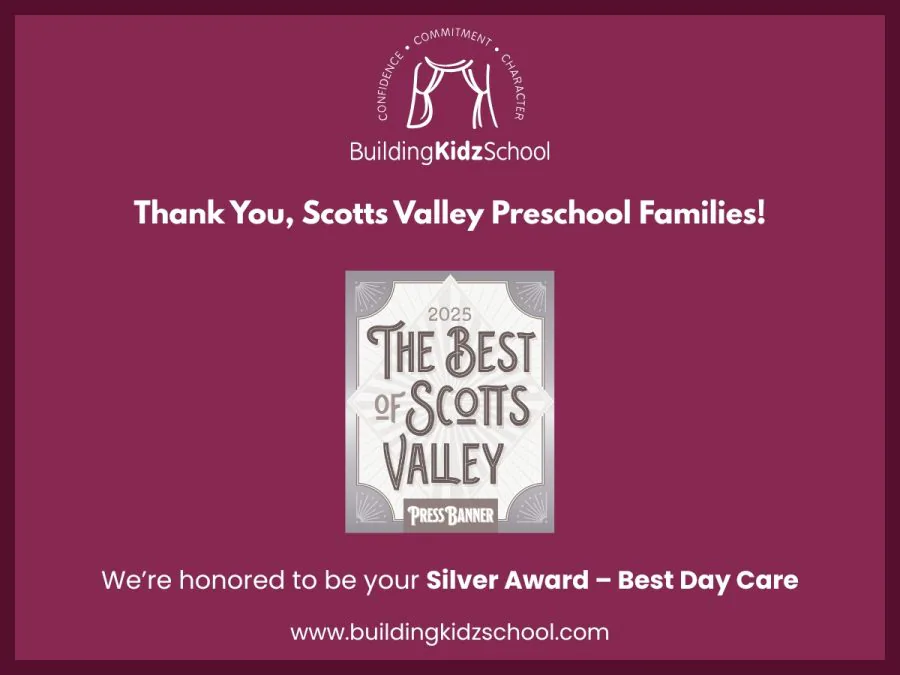
  • Silver Award Winner: Best Day Care in Scotts Valley | Best of Scotts Valley 2025

    We are proud and honored to share some exciting news with our families and community, our preschool has been awarded Silver for Best Day Care in the Best of Scotts Valley 2025 Awards!

    This recognition means so much to us because it comes directly from the families and community members we serve every day. Thank you to everyone who took the time to vote, support us, and trust us with your children’s early learning journey.

    Thank You, Scotts Valley Preschool Families & Community

    Early childhood is a crucial time for growth, discovery, and development, and we are deeply grateful that so many Scotts Valley families have chosen our preschool as a partner in their child’s education. Receiving the Silver Award for Best Day Care in Scotts Valley reflects the strong relationships we’ve built with families who value quality early childhood education, nurturing care, and a safe learning environment.

    Your continued support inspires our teachers and staff to show up every day with passion, creativity, and dedication.

    Our Commitment to Quality Early Childhood Education

    At our preschool, we focus on providing a well-rounded early learning experience that supports social, emotional, cognitive, and creative development. Our program is designed to help children feel confident, curious, and excited about learning in a warm and engaging environment.

    We are committed to:

    • Creating a safe, nurturing, and welcoming preschool setting
    • Supporting each child’s individual learning style and development
    • Encouraging creativity, exploration, and social growth
    • Building strong partnerships with families in the Scotts Valley community

    Being recognized in the Best of Scotts Valley 2025 Awards reinforces our mission to continuously improve and deliver high-quality care and education for young children.

    Proud to Serve Scotts Valley Families

    As a local preschool and day care provider, we are honored to serve the Scotts Valley community and be recognized alongside other outstanding local businesses. This award motivates us to keep raising the bar for early childhood education and to continue creating meaningful learning experiences for our students.

    Thank you again to our incredible families and community for your trust and support. We look forward to continuing this journey together and helping our children thrive—today and for years to come.

    Thank you,

  • The Benefits of Early Childhood Education

    Early childhood education (ECE) is more than just preparation for primary school. It is a pivotal time in a child’s development, laying the groundwork for their future success both academically and socially. At Building Kidz of Fairfax we believe in developing the ‘Whole-child’ with a focus on developing children who are confident, creative, and most importantly, enjoy school and learning. Our vision is to be the best preschool in Fairfax and Northern Virginia.

    Here are some of the numerous benefits of early childhood education and why it is a crucial investment in our children’s future.

    Key Benefits of Early Childhood Education

    1. Cognitive Development

    Early childhood education significantly enhances cognitive development. During these formative years, children are like sponges, absorbing information rapidly. Quality ECE programs, such as Building Kidz, introduce children to basic concepts in math, reading, and science in engaging and age-appropriate ways. These foundational skills are critical as they move forward in their educational journey.

    2. Social and Emotional Growth

    Socialization is a core component of early childhood education. Children learn to interact with peers, share, and collaborate. They also develop emotional intelligence, learning how to manage their emotions and understand others’ feelings. This social and emotional growth is essential for building strong interpersonal skills and healthy relationships.

    3. Improved Academic Performance

    Children who participate in early childhood education tend to perform better academically. Studies have shown that early education can lead to higher test scores, better grades, and a greater likelihood of pursuing higher education. By fostering a love for learning early on, ECE sets the stage for academic success.

    4. Enhanced Language Skills

    Language development is another critical area where early childhood education plays a significant role. Through stories, songs, and conversations, children expand their vocabulary and improve their language skills. Effective communication is a fundamental skill that benefits children throughout their lives.

    5. Encourages Creativity and Curiosity

    Quality early childhood education programs foster creativity and curiosity. By providing a variety of stimulating activities, such as art, music, and exploratory play, children learn to think creatively and develop a love for discovery. This curiosity drives lifelong learning and innovation. At Building Kidz one of our many differentiators is our Performing Arts program, where we incorporate all of these things within our curriculum.

    6. Builds Confidence and Independence

    Early childhood education helps children develop confidence and independence. Through structured activities and positive reinforcement, children learn to trust their abilities and take initiative. This self-confidence is crucial for personal growth and resilience.

    Conclusion

    The benefits of early childhood education are vast and far-reaching. By focusing on cognitive development, social and emotional growth, academic performance, language skills, creativity, confidence, and independence, ECE lays a solid foundation for a child’s future. Additionally, the long-term societal benefits, including economic advantages and reduced crime rates, highlight the importance of investing in early childhood education.

    Early childhood education is not just about preparing children for school; it is about setting them up for success in all aspects of life. By prioritizing and investing in ECE, we can ensure a brighter future for our children and our society as a whole.

  • Learning Through Life Experiences: A Curriculum Approach that Engages and Inspires

    In today’s fast-paced world, where technology often dominates the classroom, there’s a growing movement towards incorporating real-life experiences into early childhood education. At Building Kidz of Fairfax we embrace this movement by integrating Learning Through Life Experience in our curriculum.  

    This experiential learning approach emphasizes learning by doing, encouraging children to connect academic concepts to real-world scenarios.At Building Kidz,  by integrating LTLE educators can teach an engaging, hands-on curriculum that offers numerous developmental benefits.

    Why Life Experiences Matter in Learning

    Learning through life experiences allows children to see the relevance of what they’re learning in class by applying it to their everyday lives. Instead of abstract lessons, children are exposed to practical situations that foster engagement, critical thinking, and social-emotional growth. Here are some of the key benefits:

    1. Active Engagement and Motivation

    When children participate in real-world activities, such as visiting a police station or fire department, they become active learners. This level of engagement stimulates curiosity and motivation as they ask questions and immerse themselves in hands-on activities. For example, learning about fire safety during their time in the  fire station play structure is far more impactful than reading about it in a textbook​

    2. Real-World Problem Solving

    Experiential learning introduces children to real-world problem-solving. Whether they’re simulating how to handle an emergency at a fire station or understanding the role of police officers in maintaining safety, children learn to think critically and make decisions. At a farmers market, they may engage in budgeting or counting money to buy produce, reinforcing math skills while learning about economics​

    3. Development of Social and Emotional Skills

    Themes like a police station or fire department introduce children to community helpers, teaching them about empathy, responsibility, and the importance of teamwork. Through role-playing and interactions, children develop communication skills and learn to cooperate with others. These themes foster a deeper understanding of societal roles and cultivate social-emotional competencies like empathy and self-regulation​

    4. Multidisciplinary Learning

    Life experience-based curriculums naturally integrate multiple subjects. A visit to the observatory, for instance, can combine elements of science (astronomy), math (understanding distances in space), and literature (through storytelling about constellations or myths). Similarly, trips to a farmers market teach children about health, nutrition, and economics, offering a cross-curricular approach that enhances retention and understanding​

    5. Connection to the Community

    By exploring places like the police station and fire department, children gain an appreciation for their community. They learn about the roles these professionals play in keeping them safe, and it often sparks a sense of civic duty or interest in public service. Engaging with farmers or learning about space from experts at an observatory can also inspire future career aspirations​

    Thematic Learning Through Life Experiences

    Below are some examples of how educators can use community-based themes to enhance learning:

    1. Restaurant

    A trip to a restaurant is a common occurrence for many children. During their visit to the restaurant, childrent will ask questions about the menu, gain table manners and understand how to order at a cafe. With these exercises the children will apply essential math problems when making their order and paying their bill. They will also learn teamwork by working with their friends in the kitchen to prepare delicious meals.

    2. Fire Department

    Visiting a fire station offers opportunities to learn about fire safety, emergency response, and the importance of bravery and teamwork. Children can participate in fire drills or practice stop-drop-and-roll, making the learning experience both fun and educational.

    3. Farmers Market

    At a farmers market, children learn about healthy eating, economics, and sustainability. They can practice counting, budgeting, and even explore where food comes from, which reinforces their understanding of the environment and local agriculture. This hands-on interaction with farmers deepens their connection to their community.By creating meaningful, hands-on learning experiences, educators can cultivate a love for learning that lasts a lifetime and prepare children to thrive in a world that is increasingly complex and interconnected.

  • Choosing Quality Childcare in Queensbury and Glens Falls: What Local Parents Should Know

    If you’re a parent in Queensbury or Glens Falls weighing childcare options, you’re navigating one of the tightest markets in upstate New York — and your instinct to choose carefully is exactly right. Warren County lost 40% of its childcare facilities between 2019 and 2022, dropping from 50 providers to just 30, and workforce development officials have called the Glens Falls area “one of the biggest childcare deserts we have.” That means the families still searching aren’t being too picky. They’re being smart in a landscape where quality slots are genuinely scarce.

    Why the shortage hits our community hard

    Most households in Queensbury and Glens Falls are dual-income, with a median household income around $90,000 in Queensbury, and healthcare dominating local employment. Glens Falls Hospital alone employs 2,800 people, many of them working nontraditional hours. Reliable childcare isn’t a luxury here. It’s infrastructure. The average commute in Queensbury runs about 21 minutes, which sounds manageable until you factor in daycare drop-off and pickup windows. Parents working at Glens Falls Hospital, BD, or AngioDynamics know that a 7:00 a.m. shift doesn’t leave room for a provider with rigid hours or a long waitlist.

    The pandemic accelerated provider closures across Warren County, and recovery has been slow. A February 2025 report from the New York State Comptroller confirmed that while childcare jobs rebounded in downstate regions, upstate New York has not yet recovered. Home-based providers, historically the backbone of rural childcare, retired or closed permanently. New providers are opening, but demand still far outpaces supply.

    What research says quality early care actually looks like

    When slots are scarce, it’s tempting to grab whatever opens up. But decades of child development research point to specific markers that distinguish adequate care from the kind that genuinely shapes a child’s trajectory. The National Institute of Child Health and Human Development’s landmark study found that quality of care, not just quantity, predicted children’s cognitive and language development through elementary school.

    Here’s what early childhood experts and New York State’s own QUALITYstarsNY program say parents should evaluate. Staff-to-child ratios matter enormously, especially for infants: New York requires dedicated ratios for children under 18 months, and the best programs exceed minimums. Look for caregivers with credentials in early childhood education: a Child Development Associate (CDA) credential or a degree in the field signals intentional training, not just good intentions.

    A written, developmentally appropriate curriculum is another strong indicator. This doesn’t mean flash cards for toddlers. It means structured play, language-rich interactions, sensory exploration, and creative expression woven into the day with purpose. Programs that integrate arts, music, and movement aren’t offering extras — they’re following the science. Research published in Early Childhood Research Quarterly consistently links arts-integrated approaches with stronger social-emotional development and elementary school readiness.

    Finally, look at how a program communicates with families. Regular updates, transparency about daily routines, and genuine partnership with parents reflect a program that sees your child as a whole person with a life beyond their walls.

    Local resources that support your family beyond childcare

    One of the quiet advantages of raising young children in Queensbury and Glens Falls is the network of family resources within a short drive. Warren County’s Early Intervention Program offers free developmental screenings and therapy services for children birth through age three with no out-of-pocket cost to families. If you’ve ever wondered whether your toddler’s speech is on track, calling Warren County Health Services about the county’s Child Find program (518-761-6580) is a no-pressure first step.

    Crandall Public Library in Glens Falls runs a preschool storytime on Mondays for ages three to five. No sign-up required, just show up with your little one. The World Awareness Children’s Museum on Warren Street offers hands-on cultural exploration for five dollars, and it’s a rainy-day staple for local families. Closer to home, Hovey Pond Park in Queensbury has a barrier-free playground welcoming toddlers of all abilities, and Queensbury Parks and Recreation runs “Creative Art & Play for Tots” and parent-child swim lessons at the Gurney Lane pool each season.

    For families navigating cost concerns, it’s worth knowing that Warren County’s Child Care Assistance Program (administered through the Department of Social Services) does exist, though like many counties across New York, Warren County has experienced funding challenges and enrollment freezes in recent years. The Southern Adirondack Child Care Network at 16 Pearl St Suite 209 in Glens Falls maintains a database of regulated providers and can walk you through current options and resources available to families.

    Trusting your timeline while staying informed

    Every family’s decision about childcare follows its own rhythm, and there is no single right moment. But in a market this tight, the parents who feel most confident are typically the ones who’ve visited programs, asked specific questions about ratios and curriculum, and understood what quality looks like before a spot opens up. Queensbury and Glens Falls form a community that looks out for its families, from the volunteers maintaining Hovey Pond’s kindness rock garden to the pediatricians at Glens Falls Pediatric Consultants who’ve served this area for over four decades. Your childcare choice is simply one more way this community shows up for its youngest residents.

    Building Kidz of Queensbury is an infant-through-pre-K program on Luzerne Road, serving families throughout Queensbury and Glens Falls with arts-integrated early childhood education.

    Choosing Quality Childcare in Queensbury and Glens Falls: What Local Parents Should Know

    If you’re a parent in Queensbury or Glens Falls weighing childcare options, you’re navigating one of the scarcest markets in upstate New York — and your instinct to choose carefully is exactly right. While workforce development officials have called the Glens Falls area “one of the biggest childcare deserts we have,” this doesn’t mean you should be forced to enroll your child in any program that can squeeze them in. At Building Kidz of Queensbury, we provide top notch quality care to all our families and treat our students like our own children. 

    Why the shortage hits our community hard

    Most households in Queensbury and Glens Falls are dual-income, with a median household income around $90,000 in Queensbury, and healthcare dominating local employment. Glens Falls Hospital alone employs 2,800 people, many of them working nontraditional hours. Reliable childcare isn’t a luxury here. It’s infrastructure. The average commute in Queensbury runs about 21 minutes, which sounds manageable until you factor in daycare drop-off and pickup windows. Parents working at Glens Falls Hospital, BD, or AngioDynamics know that a 7:00 a.m. shift doesn’t leave room for a provider with rigid hours or a long waitlist.

    The pandemic accelerated provider closures across Warren County, and recovery has been slow. A February 2025 report from the New York State Comptroller confirmed that while childcare jobs rebounded in downstate regions, upstate New York has not yet recovered. Home-based providers, historically the backbone of rural childcare, retired or closed permanently. New providers are opening, but demand still far outpaces supply.

    What research says quality early care actually looks like

    When slots are scarce, it’s tempting to grab whatever opens up. But decades of child development research point to specific markers that distinguish adequate care from the kind that genuinely shapes a child’s trajectory. The National Institute of Child Health and Human Development’s landmark study found that quality of care, not just quantity, predicted children’s cognitive and language development through elementary school.

    Here’s what early childhood experts and New York State’s own QUALITYstarsNY program say parents should evaluate. Staff-to-child ratios matter enormously, especially for infants: New York requires dedicated ratios for children under 18 months, and the best programs exceed minimums. Look for caregivers with credentials in early childhood education: a Child Development Associate (CDA) credential or a degree in the field signals intentional training, not just good intentions.

    A written, developmentally appropriate curriculum is another strong indicator. This doesn’t mean flash cards for toddlers. It means structured play, language-rich interactions, sensory exploration, and creative expression woven into the day with purpose. Programs that integrate arts, music, and movement aren’t offering extras — they’re following the science. Research published in Early Childhood Research Quarterly consistently links arts-integrated approaches with stronger social-emotional development and elementary school readiness.

    Finally, look at how a program communicates with families. Regular updates, transparency about daily routines, and genuine partnership with parents reflect a program that sees your child as a whole person with a life beyond their walls.

    Local resources that support your family beyond childcare

    One of the quiet advantages of raising young children in Queensbury and Glens Falls is the network of family resources within a short drive. Warren County’s Early Intervention Program offers free developmental screenings and therapy services for children birth through age three with no out-of-pocket cost to families. If you’ve ever wondered whether your toddler’s speech is on track, calling Warren County Health Services about the county’s Child Find program (518-761-6580) is a no-pressure first step.

    Crandall Public Library in Glens Falls runs a preschool storytime on Mondays for ages three to five. No sign-up required, just show up with your little one. The World Awareness Children’s Museum on Warren Street offers hands-on cultural exploration for five dollars, and it’s a rainy-day staple for local families. Closer to home, Hovey Pond Park in Queensbury has a barrier-free playground welcoming toddlers of all abilities, and Queensbury Parks and Recreation runs “Creative Art & Play for Tots” and parent-child swim lessons at the Gurney Lane pool each season.

    For families navigating cost concerns, it’s worth knowing that Warren County’s Child Care Assistance Program (administered through the Department of Social Services) does exist, though like many counties across New York, Warren County has experienced funding challenges and enrollment freezes in recent years. The Southern Adirondack Child Care Network at 16 Pearl St Suite 209 in Glens Falls maintains a database of regulated providers and can walk you through current options and resources available to families.

    Trusting your timeline while staying informed

    Every family’s decision about childcare follows its own rhythm, and there is no single right moment. But in a market this tight, the parents who feel most confident are typically the ones who’ve visited programs, asked specific questions about ratios and curriculum, and understood what quality looks like before a spot opens up. Queensbury and Glens Falls form a community that looks out for its families, from the volunteers maintaining Hovey Pond’s kindness rock garden to the pediatricians at Glens Falls Pediatric Consultants who’ve served this area for over four decades. Your childcare choice is simply one more way this community shows up for its youngest residents.

    Building Kidz of Queensbury is an infant-through-pre-K program on Luzerne Road, serving families throughout Queensbury and Glens Falls with arts-integrated early childhood education.